Book Indexing, Publishing, & A.I.

Do androids read electric books?
Many articles, presentations, emails, blog posts, white papers, and even some books have been written on this specific topic. Here, I am adding my two cents along with links, under “Related Resources,” to some relevant publications.(1)
My Own Impressions
Based on things I’ve read and heard from tech-savvy individuals,(2) Large Language Models (LLMs) and Artificial Intelligence (A.I.) tools are good at doing very specific tasks but any attempts to create indexes fall short of anything resembling a quality product that clients or readers would be satisfied with.(3)
The fact that indexing a book requires more than simply identifying principal words in a text, means that indexing is more than just a derivative task that is ripe for automation.
When indexing a book, one must understand what the author is saying to a certain degree —enough to be able to identify important concepts — and be able to recognize when something is implied but not explicitly stated.(4)
Indexing is more than just a derivative task, ripe for automation. It is a complex and creative task that brings standardized order to an otherwise uniquely organized work.
While indexers are not creating new material, we do rely on our own creativity, as well as on our understanding of complex content and how it is structured to produce indexes that are both helpful to readers and, ideally, elegant.(5)
As of this publication (April 2026), LLMs have been unable to produce the kind of indexes that people can create.
Although A.I. is nowhere near capable of accomplishing what human indexers can do(6), that’s not to say it couldn’t(7) eventually be used as an automation tool for certain processes.(8)
Tools of the Trade
Ultimately, we may see that LLMs and A.I. do end up becoming another tool in an indexer’s toolkit — there to assist the human indexer with certain related tasks to indexing as he/she goes about the complex and creative task of bringing standardized order to an otherwise uniquely organized work.
Already, some databases and virtual libraries have begun to use A.I. tools for keyword selection, albeit with human oversight.(9) And some publishers and packagers(10) have begun attempts to create indexes with A.I.(11) Only time will tell what this new technology will mean for book indexing.
In the meantime, other publishers and authors will look for cost-effective ways to have their books indexed and may be inclined to turn to A.I. All professional book indexers have a critical responsibility to talk with their clients about the limits of LLMs/A.I.
Recent Conference Presentations on A.I.
2022 Annual Conference
“Where Do You Fit? The Art of Indexing in the Age of Automation,” Keynote presentation by Joshua Tallent
2023 Annual Conference
“New A.I. Tools and Indexing: Do We Welcome Our New Robot Overlords?” by John Magee.
2024 Annual Conference & Special Event
“The Crystal Ball is Cloudy: Artificial Intelligence, Machine Learning, and Indexing,” by John Magee. (Annual Conference)
“Artificial Intelligence and the Future of Publishing,” Keynote presentation by Thad McIlroy. (December Special Event)
2025 Annual Conference
“Indexing and Generative A.I.,” by Tanya Izzard
All professional book indexers have a critical responsibility to talk with their clients about the limits of LLMs/A.I.
Society of Indexing (S.I.) on A.I.
Burgess et al. ‘Artificial Intelligence (AI) and Indexing: Opportunities and Challenges’. China Society of Indexers 2024 conference, Beijing, October 2024. The Indexer 43, 91-100(2025). DOI:10.3828/index.2025.9
More Information
— On Book Indexing & A.I.
Google Scholar
338 Search results (as of 4/7/2026): [“book indexing” and “artificial intelligence”]
Book Indexing, Marginalia and Question/Answering with Large Language Models, p.14-15, 17-23, 69-72. Dimopoulou, Sevasti. (2025) Get PDF
Index Generation of Natural Language Text Using Artificial Intelligence Techniques. Sanford, Edith. PhD diss., 1985. | Get PDF
Semi-automated Document Indexing. Kerppola, Juho (2020)
“AI Based Digital Book Indexing System Using YAKE and WORD2VEC Methods.” Abdullah, Mohammad Alfarizi, et al. Journal of Informatics and Vocational Education 9, no. 1 (2026).
— On Book Publishing & A.I.
Thad McIlroy – Future of Publishing Artificial Intelligence Archives | Blog posts
Don't Steal This Book (website)
Publications by The Society of Authors
Like It or Not, Publishers Are Licensing Books for AI Training—And Using AI Themselves | Jane Friedman
When your publisher talks to you about A.I. | “Book Work” Substack, by Derek Krissoff
— Publisher’s Weekly Articles
1 I will begin by noting that I do not use large language models (LLMs) or A.I. tools in any way to assist in index creation or to generate indexes, nor do I upload or share client documents with A.I.
2 Several ASI listserv conversations have revolved around A.I. and its attempts at/role in book indexing; conversations with non-indexers but who are knowledgeable about LLMs and their capabilities; interviews and podcasts with so-called “tech bros;” and articles/whitepapers (cited below) that I’ve read on the topic.
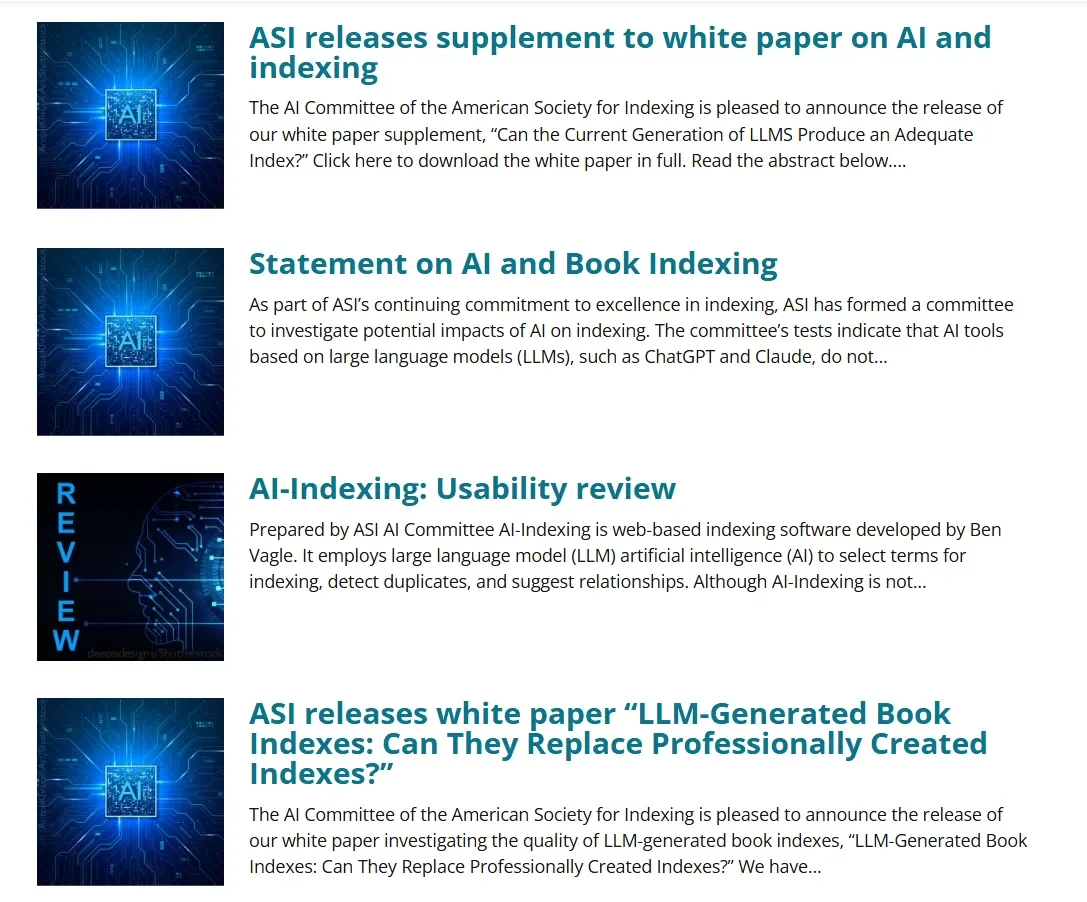
3 ASI A.I. White paper supplement (Nov 2025) — The first stumbling block was that the LLMs used for the test were unable toindex a full book due to length limits. This alone is completely unheard of for a book-indexing project, in which it goes without saying that the indexer will index the entire book and not just one chapter or a selection of chapters.
Other issues included multiple subheadings with repeated locators, and another LLM was disqualified by its production of an index with no page locators at all. (The full supplement is worth a read.)
4 Previous Substack posts on this topic:
What Is an Index? Analysis and the indexer’s role
Information Access: The Big Idea behind indexing & abstracting
Adding Value without Adding Meaning: A Note on what indexers do
5 Book indexing is a detailed process with many unique situations that occur within each book project. The fact that each book is different and has unique attributes that that require judgment calls and special attention means that the decision-making process for what to include in an index — and how to present it within the index — is complex.
6 On a more philosophical note, what’s the point of society if we remove people from all aspects of its functioning? Most indexers get profound joy and satisfaction from our creations and the knowledge that we are making information more accessible to people.
7 I don’t know if it should or shouldn’t be, but it could potentially be used.
I candefinitely say that I am annoyed when software includes A.I. as a default function that is difficult (if not impossible) to turn off.
8 2025 ASI Conference, “Indexing and Generative AI,” by Tanya Izzard.
9 This statement is based on my own conversations with other database indexers and metadata librarians.
10 I have been approached by several book packagers to work as an indexer for them. Typically, their payment rates have been criminally low though workload is apparently high, though I don’t know about actual workload because I have refused those offers outright because of the low pay.
11 This statement is based on my own conversations with other book indexers as well as some ASI listserv email threads.