Erroneous Indexing & the Importance of Editing
I’ve posted about the importance of editing an index* before; there’s a brief section on editing the index in my post about how I index books — to look at that post, one would think that editing the index is low on the list of important things to do, but actually, the editing process is just as important as compiling the index in the first place.
Editing takes at least two days of work to properly review the index, allowing for time to rest between edits. (Tired eyes will miss the most obvious of mistakes.) I also edit entries to some degree as I index, so the editing process is in no way confined to the last two days of a project.
I’ve also posted about editing in a publication about bad cross-references.
Aside from circular cross-references, there are some other issues that will be remedied by a good round or two of editing, like presenting the reader with the task of finding a needle in a haystack (i.e., too many locators), although this could also be the consequence of having an indexer who is unfamiliar with indexing best practices.
Aside from circular cross-references, there are some other issues that will be remedied by a good round or two of editing, like presenting the reader with the task of finding a needle in a haystack (i.e., too many locators), although this could also be the consequence of having an indexer who is unfamiliar with indexing best practices.
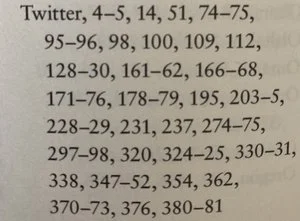
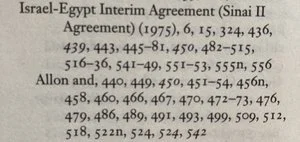
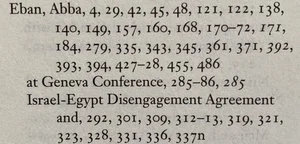
What reader will see this wall of numbers and not get frustrated? Who will spend the time to sift through so many undifferentiated page references?
More Reasons to Edit the Index Well
— Locator errors
References to the wrong page. This is basically one of the worst things that can happen for an index, since pointing readers to the correct page to find the information they are looking for is the entire purpose of having an index in the first place.
Checking page references during the editing process is one of the most important checks an indexer can do.
— Otherwise good cross references…
…that lead from a non-preferred term to a preferred term — But they fall next to each other in the index:
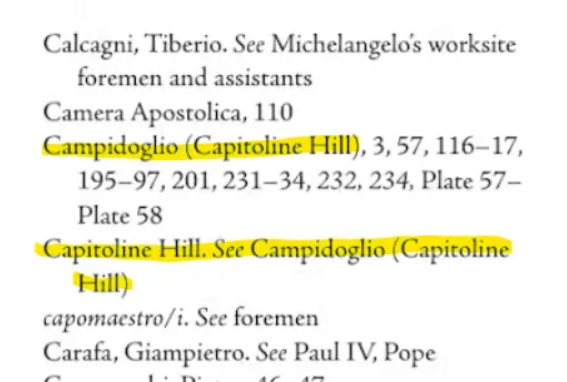
Cross reference to a neighboring entry. It looks careless because it is careless.
This index does not need both “Campidoglio (Capitoline Hill)” and the see reference from “Capitoline Hill” because they appear next to each other in the index and the name is repeated in both headings.
This see reference has wasted two entire lines that could have potentially allowed for a breakdown of the too many locators for the Campidoglio entry — there are eight, not counting the plates. A string longer than “six or so” locators should be broken down into subheadings.2 Any space saved by not breaking them down was lost by the redundant headings. Also, it looks careless.
A thorough pass at editing would have fixed this.
— Typos & other misspellings
It is something so simple, so easy to fix, but if the index is not thoroughly edited, it can be overlooked just as easily.
One good thing about indexing, though, is that this process can also identify misspellings or inconsistent spellings in the book, for example, of names — is he Jon Smith or John Smith? Tchaikovskii or Tchaikovsky? Especially when a name is transliterated into a foreign language, the rules for that transliteration may be inconsistently followed.
Any word can be misspelled, though, so checking for that is a must during editing. I always run spell-check last, before attending to last-minute formatting questions, since editing for other things can introduce new spelling errors or typos.
*This post is also published on my Substack.